Founder selling a company before moving to Spain: tax residence and exit timing
The expensive mistake is not selling a company and then moving to Spain. The expensive mistake is allowing the sale date, the relocation date, the family move, the management role, the earn-out, and the Spanish tax residence year to drift in different directions. For a founder, those facts can decide whether Spain sees a private capital gain, a Spanish-source gain, a permanent establishment issue, a corporate tax residence issue, or a post-sale wealth and reporting problem.
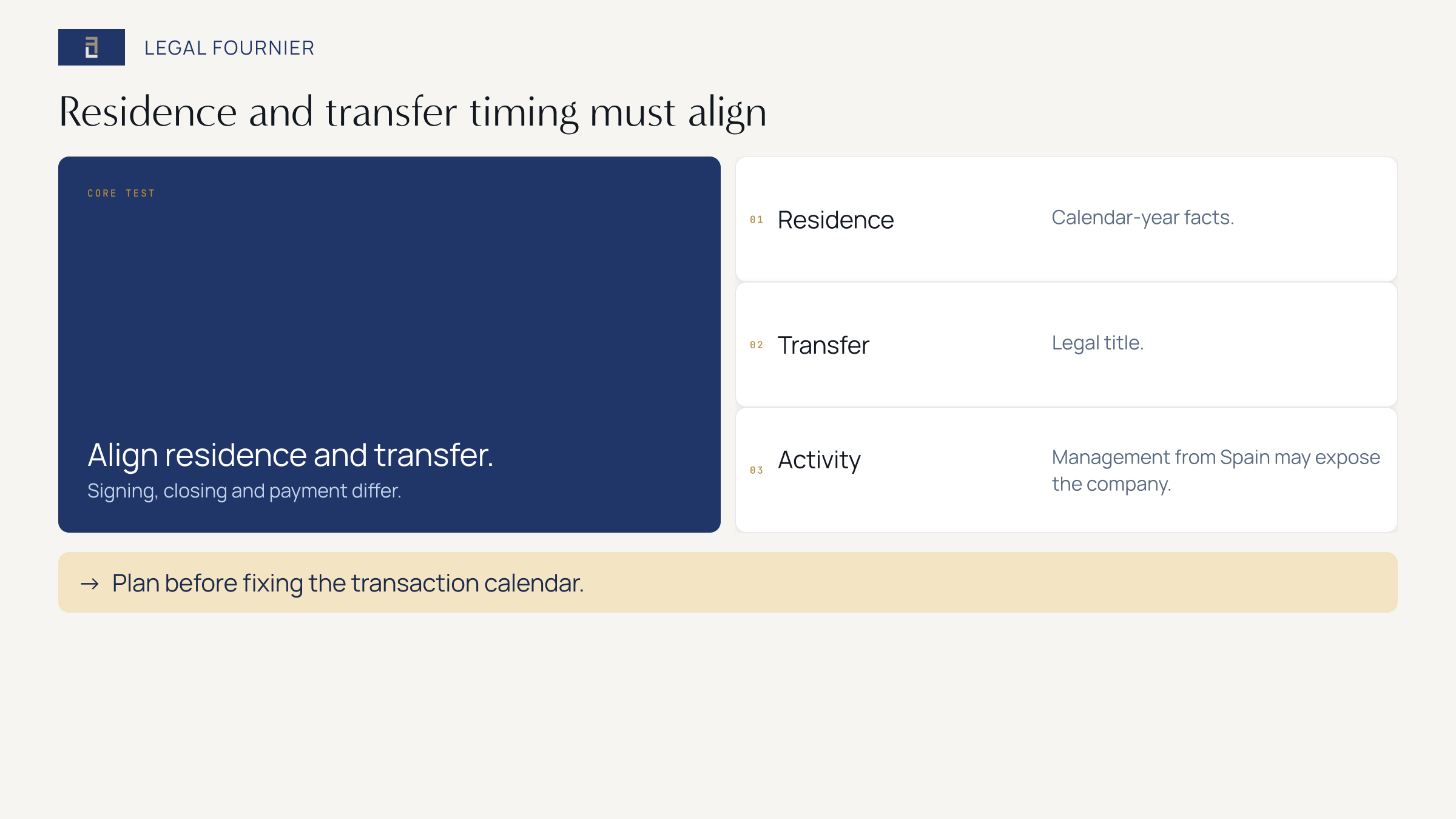
This is why “I will sell before moving to Spain” is not a complete tax plan. Spanish tax residence is assessed by the calendar year and by facts, so a tax residency Spain review should happen before the transaction calendar is treated as final. The sale may sign in one month, close in another, and pay out over several years. The founder may also continue managing the business, negotiating with the buyer, or holding rollover shares after arriving in Spain. Each of those details can change the analysis.
For private-client relocation planning, see our LATAM to Spain private-client service. If the transaction already involves Spanish premises, Spanish decision-making, or a team operating in Spain, also review our Spain permanent establishment risk checker. This article focuses on the narrower premium planning question: a founder expects a company sale and wants to time Spanish tax residence safely.
Last updated: 19 August 2026
- Spanish personal tax residence is tested by calendar year, not by visa approval, NIE issue date, lease date, or subjective intention.
- A founder can become Spanish tax resident by spending more than 183 days in Spain, by having the main centre or base of economic interests in Spain, or through the family presumption unless rebutted.
- A share sale after becoming Spanish tax resident can bring worldwide capital-gain analysis into Spanish IRPF, unless a special regime, treaty, or source rule changes the result.
- “Exit tax” can mean foreign-country departure tax, Spanish Article 95 bis when later leaving Spain, or corporate relocation tax. These are different problems.
- Negotiating, directing, contracting, or operating from Spain before closing can create permanent establishment Spain or effective-management questions for the company, separate from the founder’s private gain.
- Post-sale cash and shares can trigger Spanish bank KYC, Modelo 720 reporting, wealth tax, and solidarity tax review even when the original sale was closed outside Spain.
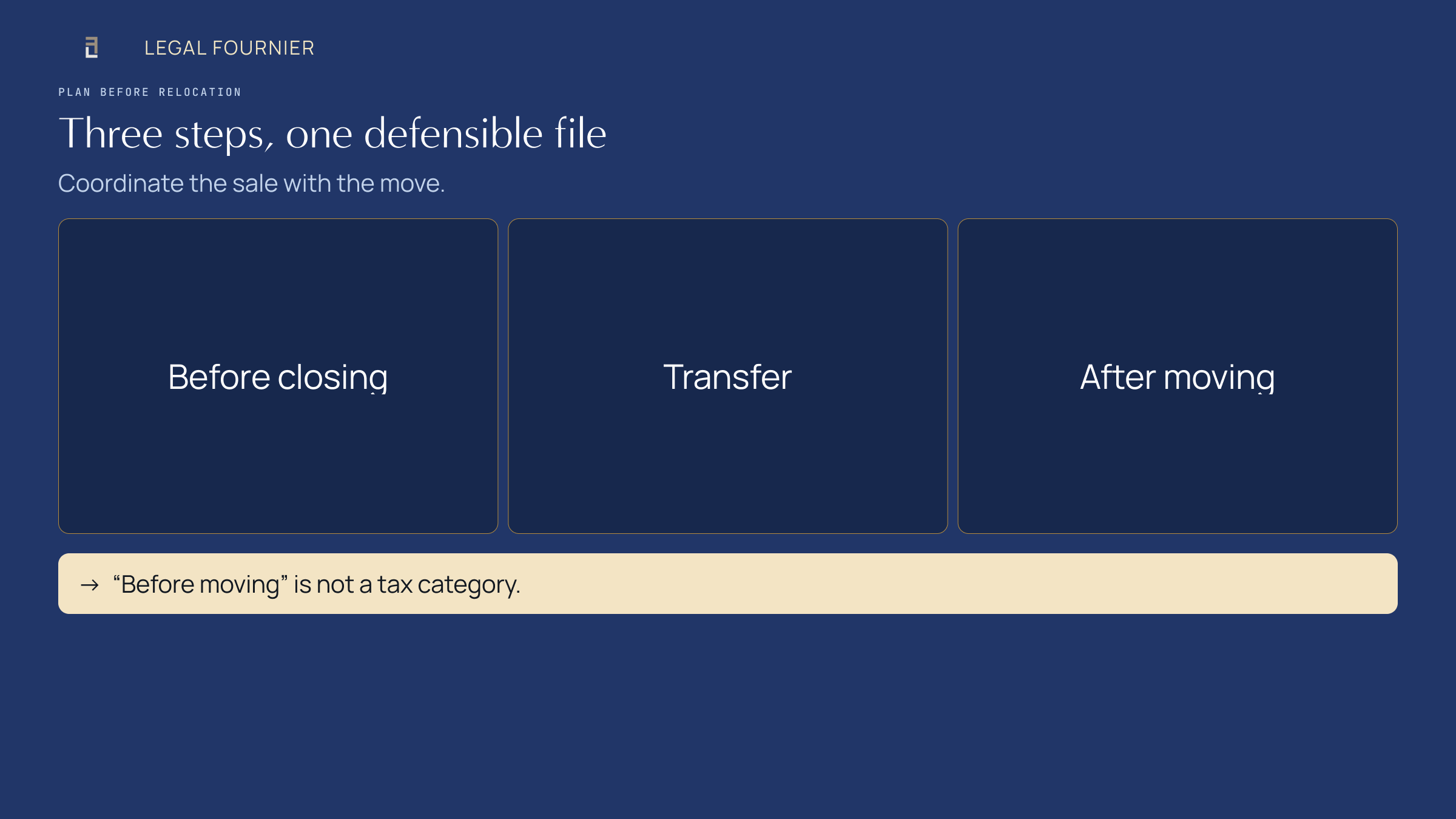
“Before moving” Is not A tax category
Founders often ask whether they should sell before obtaining a Spanish visa, before signing a lease, before registering the family, or before crossing 183 days. Those are all relevant facts, but none of them is the whole test. Under Spanish personal income tax law, an individual is generally treated as tax resident in Spain when either of two principal criteria is met: the person remains in Spain for more than 183 days during the calendar year, or the main centre or base of the person’s activities or economic interests is in Spain, directly or indirectly.
The Spanish Tax Agency’s guidance on individuals resident in Spain also reflects the family presumption: unless proved otherwise, Spain may presume habitual residence when the non-legally separated spouse and dependent minor children habitually reside in Spain. The statutory basis is Article 9 of the Spanish Personal Income Tax Law.
For a founder, the centre-of-economic-interests limb is often more important than the day count. A founder who spends fewer than 184 days in Spain may still create a Spanish-residence argument if the main economic base has shifted to Spain: board decisions, buyer negotiations, a Spanish home office, local staff, family settlement, and post-sale investment management can all become evidence.
If another country also treats the founder as resident, the applicable double-tax treaty may contain tie-breaker rules. The AEAT’s page on residence in two countries describes the usual sequence: permanent home, closer personal and economic relations, habitual abode, nationality, and mutual agreement when needed. A treaty tie-breaker is not a casual planning label. It requires evidence and may not solve every Spanish domestic filing or information obligation.
The practical test is this: was the founder still genuinely outside Spanish tax residence when the taxable share transfer occurred, and can the file prove it if AEAT, a foreign tax authority, a bank, or a buyer asks later?
How Spain looks at the company sale
When a Spanish tax resident sells shares, Spain normally starts from a broad personal tax principle: Spanish tax residents are subject to Spanish personal income tax on their income under the IRPF framework. A share sale is usually analysed as a capital gain or loss, a ganancia o perdida patrimonial, if the transaction changes the value and composition of the taxpayer’s assets and the law does not classify it as another type of income.
AEAT’s guidance on capital gains in the savings tax base explains that gains and losses arising on transfers of assets are integrated into the savings base. The statutory concepts are in Articles 33 and 46 of the Personal Income Tax Law. The exact calculation, timing, foreign tax credits, treaty position, and currency conversion needs review transaction by transaction.
If the founder is not Spanish tax resident when the sale occurs, Spain does not automatically tax every foreign company sale. But the analysis cannot stop there. The Spanish Non-Resident Income Tax Law can treat certain gains as obtained in Spain, including gains connected with Spanish-resident entities or entities that derive value from Spanish real estate in the circumstances set by law. The relevant source rules are in Article 13 of the Non-Resident Income Tax Law.
The cleanest planning file identifies four facts before flights or completion documents are fixed: the seller’s residence in the sale year, the legal transfer date, the source and nature of the shares, and the ongoing Spanish activity of the founder or company.
| Scenario | Main Spanish issue | Evidence to prepare |
|---|---|---|
| Foreign company sold and closed before Spanish tax residence | Usually lower Spanish personal tax risk, but foreign exit tax and treaty evidence remain important | Closing date, share-transfer instrument, payment trail, residence certificate, day-count file |
| Spanish SL or Spain-rich company sold by non-resident founder | Spanish-source gain and treaty relief analysis under non-resident rules | Share register, corporate balance sheet, treaty residence certificate, buyer withholding review |
| Signing before Spain, closing after Spanish residence begins | The taxable transfer may occur after the founder is resident | SPA conditions, completion mechanics, title transfer, board approvals, escrow terms |
| Earn-out, escrow, vendor loan, or deferred price after moving | Timing and classification of later payments can be sensitive | Payment formula, contingencies, due dates, accounting treatment, tax elections where available |
| Founder keeps rollover shares and later leaves Spain | Future Spanish exit-tax and wealth-tax planning may become relevant | Acquisition values, market values, ownership percentage, residence history, future exit plan |
Signing, closing, earn-out: the date that matters may not be the date in your head
A letter of intent is not the same as a binding sale. A signed share purchase agreement may still be subject to conditions precedent. A closing memorandum may transfer title on a later date. An escrow may delay cash but not necessarily ownership. An earn-out may be contingent on future performance, employment, or warranties. A vendor loan may make the founder a creditor of the buyer after closing.
Spanish tax analysis usually needs the moment of the patrimonial alteration: when the shares or rights are transferred, what consideration is received or becomes enforceable, and whether later amounts are sale price or another income category. AEAT guidance on operations with deferred price reflects that Spanish IRPF has special timing rules where the price is collected through successive payments and the period between delivery or availability and the final payment exceeds one year.
That does not mean every earn-out is automatically safe or deferred. Contract wording, transfer mechanics, conditions, and residence status in each year matter. Tax counsel should read the SPA before it is signed, not after the economics are locked.
Where “exit tax” actually fits
The phrase “exit tax” causes confusion because founders use it for different taxes. The first is the exit tax or deemed-disposal rule in the country the founder is leaving. Spain cannot answer that question alone. If the founder is tax resident in Mexico, Colombia, the United Kingdom, France, the United States, or another country before moving, local counsel in that jurisdiction must confirm whether emigration, loss of residence, or a pre-move sale triggers a local charge.
The second is Spanish inbound taxation. Spain does not impose a general tax merely because a founder enters Spain with previously taxed cash. But once resident, Spain may tax worldwide income, may require foreign-asset reporting, and may apply wealth-tax rules depending on the profile. The difference between “cash already received before residence” and “capital gain arising after residence” is central.
The third is Spain’s own outbound exit-tax rule for individuals. Article 95 bis of the Personal Income Tax Law can deem certain unrealised gains on shares or participations to arise when a taxpayer loses Spanish tax residence, if the person has been Spanish tax resident for at least ten of the previous fifteen tax periods and the statutory value or ownership thresholds are met. Broadly, the thresholds include total share values above EUR 4,000,000 or values above EUR 1,000,000 where the taxpayer holds more than 25 percent in the entity.
For an inbound founder, Article 95 bis is usually not the first-year problem. It becomes relevant when the founder keeps shares, accepts rollover equity, moves the holding structure to Spain, or expects to leave Spain after several years.
Planning point: do not ask only “Will Spain tax the exit?” Ask which country taxes the departure, which country taxes the sale, and whether Spain will later tax retained shares when the founder leaves Spain.
Permanent establishment Spain: the hidden deal-room risk
The founder’s personal share sale is only one layer. The company being sold may also create Spanish tax exposure if business activity is carried out from Spain before closing. AEAT’s definition of permanent establishment refers to a non-resident carrying out economic activities in Spain through facilities or workplaces used continuously or habitually, or through an agent authorised to contract in the name and on behalf of the non-resident who habitually exercises those powers.
That definition matters when a founder arrives in Spain before closing and continues acting as CEO. A home office in Madrid, Spanish employees, buyer negotiations from Spain, Spanish customer contracts, or signing authority exercised from Spain can all create questions. The answer may be “no permanent establishment” in a controlled file, but the risk should be managed before Spain becomes the deal headquarters.
If a permanent establishment exists, AEAT’s page on taxation of permanent establishments explains that the PE is taxed on income attributable to it and has separate accounting and filing obligations. This is why a buyer, an investor, or a later audit may ask where the company was actually managed during the sale process.
There is also a corporate tax residence layer. Under Article 8 of the Corporate Tax Law, an entity can be resident in Spain if it was incorporated under Spanish law, has its registered office in Spain, or has its place of effective management in Spain. If the founder moves to Spain and the direction and control of the foreign company as a whole also moves to Spain, the issue may be more serious than a small PE footprint.
Red flags during the sale process
- The founder relocates to Spain before closing but continues to sign customer, supplier, or buyer-side documents for the foreign company.
- The company’s principal board or executive decisions begin taking place from Spain.
- The founder tells the buyer, bank, or employees that Spain is now the operating headquarters.
- The foreign company hires Spanish staff or contractors before a Spanish structure is ready.
- The founder uses a Spanish office, coworking space, or home address as a habitual business base for the target company.
The cleaner pattern is usually to coordinate closing, physical relocation, management authority, Spanish payroll or contractor onboarding, and governance minutes. The objective is a coherent commercial story: who sold the shares, when they were sold, where the company was managed, and when Spanish operations began.
Article 93 and Beckham law are not A substitute for exit planning
Spain’s special regime for inbound workers, professionals, entrepreneurs, investors, and certain family members is often called the Beckham Law regime. AEAT’s Article 93 special-regime guidance explains that eligible individuals who acquire Spanish tax residence as a result of moving to Spain may opt to be taxed under the Non-Resident Income Tax rules, with special features, while remaining IRPF taxpayers. The reform applicable from 2023 expanded the regime to new profiles and reduced the prior non-residence period to five years, subject to conditions.
For founders, the regime can be valuable, but it is not a magic wrapper for every exit. The file must test why the founder is moving, whether the role fits an eligible category, whether income would be obtained through a permanent establishment in Spain, whether the shares are Spanish-source or foreign-source, and whether the option is filed correctly.
In practice, the Article 93 analysis should be completed before closing a transaction that depends on it. If the sale is of a foreign company and the founder expects the gain to fall outside ordinary worldwide IRPF taxation, counsel must still verify source rules, treaty interaction, timing, eligibility, and documentation. A founder should not sign the SPA on the assumption that a future Beckham filing will repair an already taxable event.
After the sale: cash, foreign assets, wealth tax, and bank KYC
Even if the company sale closes before Spanish tax residence, the post-sale asset position still needs Spanish planning. A founder may arrive with foreign bank accounts, brokerage accounts, escrow rights, rollover equity, loan notes, insurance products, or a family holding structure. Spain may not be taxing the original pre-residence gain, but the assets can still be relevant once the founder becomes Spanish tax resident.
AEAT’s page for Form 720 describes the information return for assets and rights located abroad. The model covers three broad reporting obligations under the General Tax Management Regulation: foreign financial accounts, foreign securities or rights, and foreign real estate or rights over real estate. Whether a particular founder must file depends on the assets, values, exemptions, and history. It should be reviewed before the first Spanish resident filing season, not after a warning letter.
Wealth tax also matters for liquidity planning. Under Article 5 of the Wealth Tax Law, Spanish residents subject to personal obligation are taxed on their worldwide net wealth, subject to the rules, exemptions, regional provisions, and treaties that apply. The separate Temporary Solidarity Tax on Large Fortunes is designed as a complementary state tax on net wealth above EUR 3,000,000 in the terms set by the statute. The interaction with regional wealth tax, Article 93, family assets, and exempt business assets needs specialist review.
Finally, Spanish banks do not treat a large founder-exit transfer as ordinary account funding. Banks and other obliged entities must carry out anti-money-laundering due diligence. SEPBLAC’s due-diligence guidance describes identification and beneficial-owner checks before business relationships or operations. Law 10/2010 gives the statutory framework for anti-money-laundering and counter-terrorist-financing obligations.
A strong bank file normally includes the share purchase agreement, closing statement, proof of historic share acquisition, cap table, tax residence documents, source of funds narrative, foreign tax filings, beneficial-owner chart, and explanation of where funds were held between closing and arrival. This is administrative, but it is also strategic: a premium relocation can be delayed by bank compliance even when the tax analysis is sound.
A practical planning map before the founder moves
For founders, the right planning sequence is usually not “sell, fly, then ask the accountant.” The file should be mapped while the sale is still negotiable and before Spain becomes the day-to-day base.
1. build the residence file
Prepare a calendar-year day count, travel history, housing evidence, family timeline, school or registration dates, business activity map, and tax residence certificates where available. AEAT’s tax residence certificate page notes that certificates are issued if Spanish residence can be inferred from the data held by the Tax Agency. For pre-move planning, foreign residence certificates can also be important to prove the other side of the timeline.
2. read the transaction documents for tax timing
Tax counsel should review the letter of intent, SPA, conditions precedent, closing deliverables, shareholder consents, option agreements, earn-out formula, escrow, warranties, deferred price, and rollover equity. The issue is not only the headline closing date. It is when the taxable rights and obligations arise.
3. separate personal sale planning from company activity planning
The founder may personally sell shares, while the company may separately create Spanish corporate tax exposure if management or business activity moves early. Keep board minutes, signing authority, employment decisions, buyer communications, and Spanish work patterns consistent with the intended tax position.
4. model the first Spanish resident year
The first resident year should include income tax, possible Article 93 election, wealth tax, solidarity tax, Modelo 720, foreign tax credits, treaty certificates, family members, and banking. For many founder exits, the cash management plan is as important as the sale itself.
Three founder examples
Example 1: LATAM founder closes before relocation. A Colombian founder signs and closes the sale of a non-Spanish operating company while still resident outside Spain. The family move and executive activity start only after closing. Spain may have limited personal income-tax interest if there is no Spanish source, but the file still needs proof of residence, closing, foreign tax treatment, banking, and post-arrival reporting review.
Example 2: Founder moves to Madrid before completion. A founder signs the SPA in February, moves to Madrid with family in March, continues running the company from Spain, and closes in July. Signing happened before arrival, but the taxable transfer may occur after Spain has a residence argument. The company may also have PE or effective-management risk.
Example 3: Founder rolls over into the buyer group. A founder sells part of the company, receives cash, and keeps valuable rollover equity. Later earn-outs, dividends, management fees, wealth tax, Modelo 720, and possible future Spanish exit tax all need mapping because not all value converted to cash before residence.
Legal fournier’s view
For a founder exit, timing is not only a tax rate question. It is a credibility question. If the facts show that the founder was already resident in Spain, managed the business from Spain, closed after Spanish residence began, or held substantial foreign assets after arrival, a thin memo prepared after the event will not fix the file.
Legal Fournier’s role in this type of matter is to coordinate Spanish tax residence, permanent establishment, Article 93 eligibility, private wealth reporting, bank onboarding, and relocation documents into one defensible plan. For substantial exits, that work should happen before the final transaction timetable is signed.
If the sale is already under negotiation, speak with a Spanish lawyer through our consultation route. If the transaction will require Spanish filings after arrival, our income tax filing support can be coordinated with the wider private-client strategy.
FAQ
If I sell before getting a Spanish visa, is the gain outside Spain?
Not automatically. Visa status is not the tax residence test. Spain looks at calendar-year presence, economic interests, family facts, and source rules. A pre-visa sale may still need review if closing, payment rights, management activity, or Spanish-source shares are involved.
Does Spain count days before I obtain a NIE or TIE?
Yes. A NIE or TIE is not what starts the day count. Travel records, leases, family arrival, school, and business activity can all matter.
What if I close before reaching 183 days in Spain?
That can help, but it is not always decisive. Spain can also look at the centre or base of economic interests, and the whole calendar year must be tested. If family and business life have already moved to Spain, closing before day 184 may not be enough.
Can Beckham law protect the company sale?
It depends. Article 93 can materially change the tax analysis for eligible inbound taxpayers, but it requires a valid qualifying move, correct filing, and detailed source and permanent-establishment review. It should not be assumed after the sale has already closed.
Is Spanish exit tax due when I move to Spain?
Spain’s individual exit-tax rule in Article 95 bis is generally an outbound rule for taxpayers leaving Spain after a period of Spanish residence and meeting statutory share-value or ownership thresholds. The country you are leaving may have its own exit tax, so foreign departure advice is still essential.
Can I transfer the sale proceeds to a Spanish bank?
Often yes, but the bank will usually require a source of funds and beneficial-owner file: SPA, closing statement, tax documents, cap table, and proof of the route the funds took before arrival in Spain.