Retire in Spain: NLV Income, Health Insurance and Tax Checks
The phrase Spain retirement visa is convenient, but it is not the name used in Spanish law. For a non-EU, non-EEA or non-Swiss national who plans to live in Spain without working, the relevant route may be the autorización inicial de residencia temporal no lucrativa: initial temporary non-lucrative residence.
Before gathering bank statements, check whether your actual plans fit a route that does not permit labour or professional activity. If those plans include remote work, consultancy, management duties, a company role or another activity that is hard to classify, pause and get advice on the correct route before preparing the rest of the application. Article 61 of Real Decreto 1155/2024 contains the legal definition, but it does not settle every modern working arrangement.
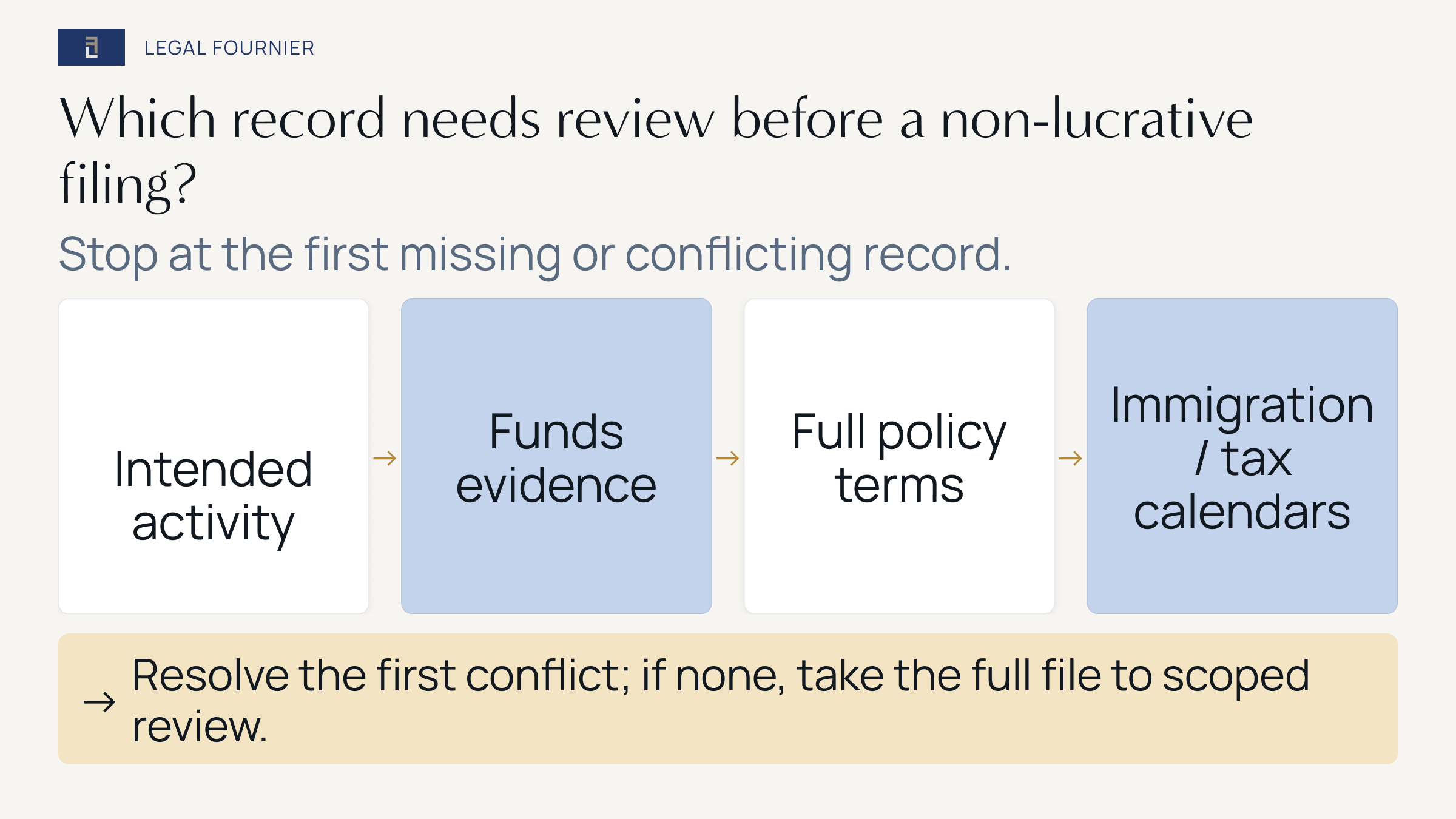
Put these four records side by side before you apply
| Record | What it can show | Reason to stop and review |
|---|---|---|
| Statement of intended activity | Whether the plan appears consistent with residence without labour or professional activity | Continuing work, consulting, management or an uncertain company role |
| Funds or periodic-income evidence | Whether the amount, period and family calculation are addressed | The income depends on activity, or the evidence covers the wrong period or family composition |
| Policy certificate and complete insurance terms | Whether the policy can be compared with the national rule and the competent consulate’s current instructions | The certificate and full terms differ, or a material limit cannot be matched to an official requirement |
| Dated travel and residence calendar | Whether the intended presence fits the immigration renewal rule | The same day count is being used as though immigration renewal and tax residence were one test |
This is a conflict check, not a complete checklist of documents or an eligibility result.
What the non-lucrative route covers
Article 61 of Real Decreto 1155/2024 permits temporary residence for the applicant and qualifying family members without labour or professional activity. Its family definition includes a spouse, registered partner or properly evidenced stable partner; certain unmarried minor children; and some adult children who need support because of disability or who cannot objectively provide for themselves because of their health. Calling this simply “spouse and children” drops conditions that matter. The initial authorisation lasts one year.
Under the same Article 61 requirements, the applicant must show sufficient means for maintenance and residence without needing labour or professional activity, hold health insurance, pay the fee, not be subject to an unexpired commitment not to return to Spain arising from voluntary return, and have no disqualifying public-order, security or public-health issue. Each application must include evidence for every applicable requirement. For a broader introduction, see our guide to Spain’s non-lucrative visa requirements.
Calculate the legal minimum, then examine the evidence
Article 62 of Real Decreto 1155/2024 sets monthly minimum means at 400% of IPREM for the main applicant and a further 100% of IPREM for each qualifying dependent family member. The total required amount is the monthly figure multiplied by the number of months in the requested authorisation period. Funds held for that period or a periodic source of income may be used.
Worked illustration using the monthly IPREM observed on 4 September 2026
- The SEPE table checked on that date reported a monthly IPREM of EUR 600 and cited Law 31/2022 as its source.
- Main applicant: 400% × EUR 600 = EUR 2,400 per month; for a one-year initial authorisation, EUR 2,400 × 12 = EUR 28,800.
- Main applicant plus one qualifying dependent: EUR 3,000 per month; for one year, EUR 36,000.
The law refers to minimum amounts at application or renewal. IPREM must be checked again for the relevant filing date. Correct arithmetic does not prove that the evidence is sufficient or that an application will be approved.
The total amount is only part of the documentary analysis. Article 62 allows evidence admissible in law and gives examples, including property titles, certified cheques and credit cards supported by a bank certificate. For a foreign account, the information described in the article includes the financial institution and account identification, the relevant dates on which the account was opened or closed, or authority over it was granted or withdrawn, the previous 31 December balance and the prior year’s average balance. These are statutory examples and fields, not a promise that one portfolio statement or certificate will be accepted everywhere.
The same Article 62 provision has a narrow rule for company interests. If the means come from shares or interests in Spanish, mixed or foreign companies established in Spain, the company must certify that the person carries out no labour activity in it, and the applicant must provide a responsible declaration. That wording should not be extrapolated to every foreign company, directorship or ownership structure. If the activity is unclear, resolve that question before preparing the rest of the application.
Insurance and consular documents need their own comparison
The Ministry of Inclusion’s Information Sheet 6 lists form EX-01, a complete passport valid for at least one year, criminal-record evidence for the previous five years where applicable, proof of means, health-insurance documentation and a medical certificate. It says documents from other countries must be translated by a sworn translator into Castilian or the co-official language of the territory where the application is filed. Foreign public documents must also be legalised or apostilled unless an exemption applies.
National guidance requires public or private health insurance with an insurer authorised to operate in Spain. It does not, by itself, decide whether a specific certificate or policy is acceptable. Read the complete terms, including any copayment, waiting period, reimbursement condition, territorial limit or exclusion, and compare them with the competent consulate’s current official instructions. The applicable document list, validity rules, appointment system and territorial jurisdiction must be checked for that consulate when the application is prepared.
The application is made through the competent Spanish consular office, and the visa application also entails the residence-authorisation application. Article 63 gives the immigration authority a maximum of one month from receipt of the consular communication. If it does not decide within that period, silence is treated as negative at that stage. That one-month period does not measure total consular processing time or appointment availability. After entering Spain, the holder must apply personally for the TIE within one month.
The two 183-day questions are not interchangeable
| Immigration renewal | Tax residence |
|---|---|
| Article 64 requires real and effective residence in Spain for more than 183 days during the calendar year, alongside continued insurance, the required means for the renewal period, schooling where applicable and payment of the fee. | AEAT’s domestic tests include more than 183 days in Spain, applying its stated rules for sporadic absences, or having the principal centre or base of activities or economic interests in Spain. AEAT also describes a rebuttable family presumption where the non-separated spouse and dependent minor children habitually live in Spain. |
Article 64’s immigration rule does not replace the AEAT tax-residence analysis. AEAT states that administrative residence and tax residence can differ and treats a person as resident or non-resident for the whole calendar year. If two countries treat the person as resident, the applicable tax treaty must be read. AEAT describes the common sequence of permanent home, closer personal and economic relations, habitual abode, nationality and, if needed, agreement between the competent authorities. The actual treaty and facts decide whether that sequence applies.
You can use our tool to screen the separate Spanish tax-residence question, but it cannot replace a review of the relevant domestic rules, treaty and personal facts.
Plan the renewal before the first year ends
Under Article 64 of Real Decreto 1155/2024, the ordinary filing window opens during the two months before the initial authorisation expires. A filing within three months after expiry may also extend validity while the decision is pending, but the authorities may still start sanction proceedings; that is not a recommended grace period. File before expiry where possible.
Article 64 also allows tax and Social Security non-compliance during the authorisation to be assessed at renewal. This is not an automatic-refusal rule, nor does it establish whether the holder is tax resident. A renewed authorisation generally lasts two years unless the holder qualifies for long-term residence. The maximum decision period is three months, and silence is treated as positive. Once notified, the renewed TIE must be requested personally within one month.
When the documents are telling you to stop
Do not keep collecting documents if the intended activity conflicts with the route, the funds depend on that activity, the policy certificate does not match the full terms, or the immigration and tax calendars assume that one 183-day rule answers both questions. Resolve the conflict first. If a refusal has already been notified, this planning guide is no longer the right starting point. Review the decision and current deadline rather than assuming a new application or appeal is suitable; our separate guide covers non-lucrative visa refusal evidence.
This article is general information based on sources checked on 4 September 2026, not advice on a particular application, insurance policy, tax treaty or consulate. A case-specific review can compare the intended activity, Article 62 evidence, full policy terms, the correct filing place and the separate tax calendar. The consultation options explain how to request that review. Do not place confidential documents in the public form.