

Holding company in Spain: substance, banking and tax risks for LATAM groups
A holding company in Spain for a LATAM group can be a serious planning tool. It can also become an expensive weak point if the structure is incorporated before anyone has mapped substance, bank due diligence, related-party flows and permanent establishment Spain exposure. The legal risk is rarely the certificate of incorporation itself. The risk is whether the company can explain what it does, who controls it, where decisions are made and why Spain is the right place for the holding function.
This is especially important for family-owned groups, founders and private clients from Latin America who want a European platform for investments, Spanish operations, property, financing or future relocation. A Spanish company may be easy to sign before a notary, but a bank, the AEAT and foreign tax authorities will look beyond the deed. Before forming the company, the structure should be connected to company formation advice in Spain, banking strategy and international tax analysis.
This article does not argue that every LATAM group needs a Spanish holding company. It explains the narrower edge case: when a Spanish holding may make sense, what substance usually has to prove, why bank onboarding can fail, and how a holding structure can accidentally create or expose a Spanish permanent establishment problem.
Where the structure is still being designed, the Spain holding company structure checker can flag substance, ETVE and management-location issues before the notary file starts.
Last updated: 4 June 2026 · Based on AEAT guidance, the Corporate Income Tax Law, the Non-Resident Income Tax Law, Spanish anti-money-laundering rules, the Ley General Tributaria and Banco de Espana guidance.
Key takeaways for LATAM groups
- A Spanish holding is not just a box. The file should explain the business reason for Spain, the governance function, decision-making process and expected flows.
- Permanent establishment risk is separate from incorporation. A Spanish entity may be clean, while the LATAM operating company still creates risk through people, offices, contracts or habitual agents in Spain.
- Bank risk is evidence risk. Spanish banks must identify beneficial owners, understand the purpose of the business relationship and monitor transactions. A substantial group needs a bankable narrative, not only documents.
- ETVE treatment is not automatic. The Spanish holding regime for foreign securities has specific conditions, including an object covering management of foreign participations through material and personal means.
- Related-party pricing must be planned early. Management fees, loans, guarantees, royalties and service charges inside the group need market-value support.
The real question: what will the Spanish company actually do?
A Spanish holding company should not be designed backwards from a tax result. The first question is operational: what function will sit in Spain? Possible answers include holding participations in operating companies, centralizing European investment, coordinating Spanish property or business assets, receiving dividends, making shareholder loans, employing management, or acting as a regional platform.
Each answer creates a different risk map. A passive investment holding with foreign shareholders is not the same as a Spanish entity that negotiates contracts for the group, employs executives, pays management fees, owns Spanish real estate or directs subsidiaries abroad. The legal form may still be a Sociedad Limitada, but the tax and banking file is completely different.
For a LATAM group, the strategic issue is not “can we incorporate in Spain?”. It is “can the Spanish company defend why it exists, where it is managed, and how money will move through it?”.
In practice, we would normally split the planning into four files before incorporation:
- Corporate file. Shareholders, directors, bylaws, powers, board procedure, accounting obligations and annual-account discipline.
- Tax file. Spanish tax residence, permanent establishment analysis, participation exemption, related-party transactions, dividend and interest flows, treaty position and anti-abuse risk.
- Bank file. Beneficial ownership, source of wealth, source of funds, expected account use, contracts, invoices, group chart and transaction rationale.
- Evidence file. Foreign registry extracts, apostilles or legalizations, sworn translations where needed, board minutes, shareholder resolutions and historic tax documents.
Spanish tax residence: incorporation, domicile and effective management
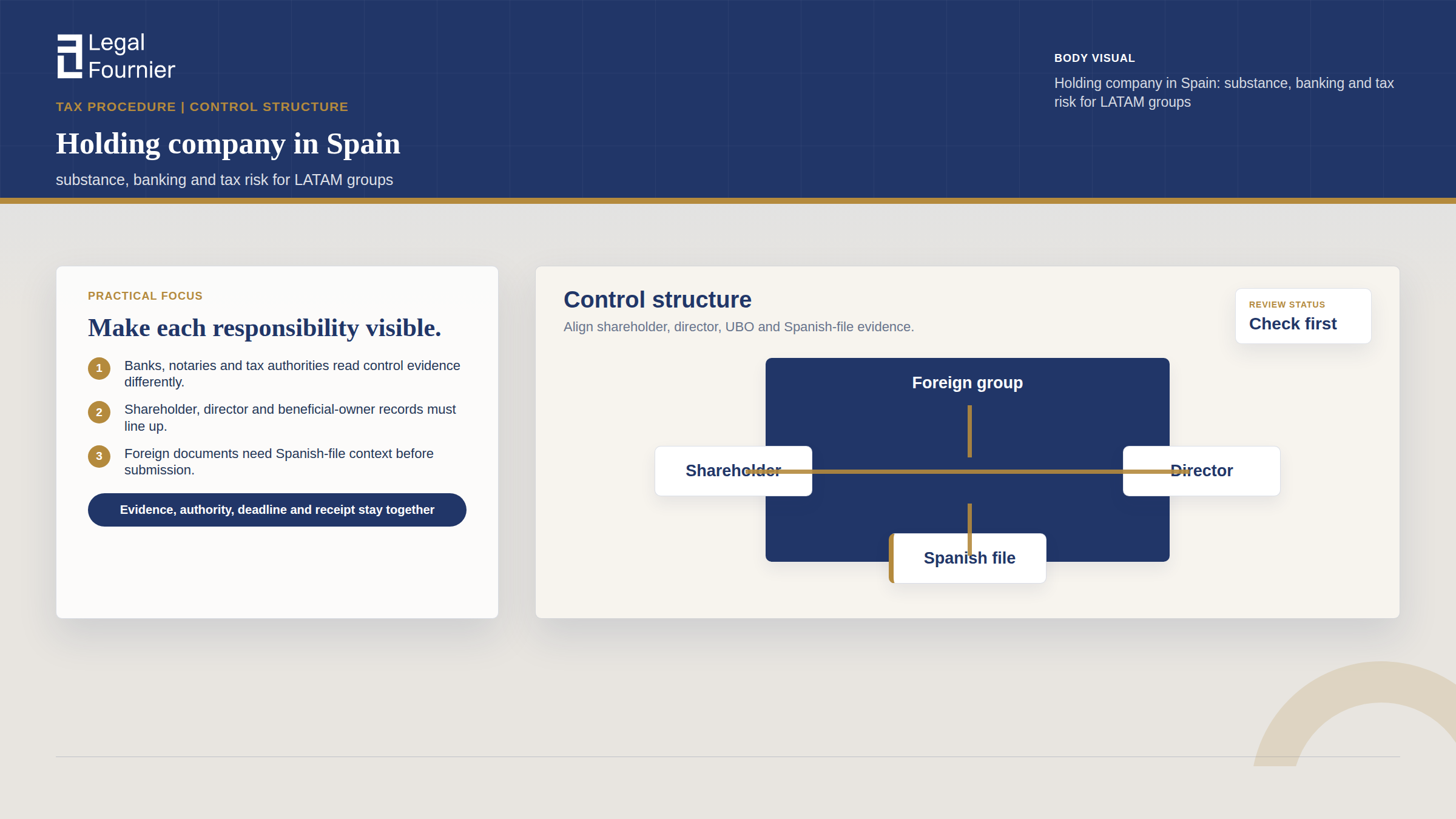
The Spanish Corporate Income Tax Law treats an entity as Spanish tax resident when it meets any of the core residence tests: incorporation under Spanish law, registered office in Spain, or sede de direccion efectiva in Spain. The law states that effective management is in Spain when the direction and control of the entity’s overall activities are located there. The AEAT’s corporate tax manual reflects the same criteria.
For a Spanish SL used as a holding company, the incorporation and registered-office tests are usually straightforward. The more sensitive point is evidence of management. If directors live outside Spain, decisions are taken in another country, Spanish minutes merely rubber-stamp decisions already made abroad, and the Spanish address is only a mailbox, the holding company may still exist legally, but its planning value can be weakened.
The opposite mistake is also common: assuming that a Spanish address and Spanish bank account prove substance by themselves. They do not. Substance is built through the alignment of governance, people, decision-making, accounting, contracts and records. Where the facts are complex, the file should explain why certain decisions are taken in Spain and which decisions remain with foreign operating companies.
Permanent establishment Spain: the LATAM group risk
The ranking keyword behind this topic is permanent establishment Spain, and it is the right lens. A group may incorporate a Spanish holding company and still have a separate permanent establishment issue for a LATAM operating entity. The problem is not the holding company alone. It is the activity carried out in Spain by people, offices, agents or decision-makers on behalf of a foreign company.
Under Spain’s Non-Resident Income Tax Law, a non-resident person or entity can operate through a Spanish establecimiento permanente when it has, on a continuous or habitual basis, facilities or workplaces in Spain where it performs all or part of its activity, or when it acts in Spain through an agent authorized to contract in the name and on behalf of the taxpayer who habitually exercises those powers. AEAT explains this internal-law test in its Modelo 036 guidance.
Where a double tax treaty applies, the analysis cannot stop at domestic law. AEAT states that the specific treaty article defining permanent establishment needs to be checked, and that Spanish treaties are generally based on the OECD model but needs review case by case. That is particularly relevant for LATAM groups because the treaty position may differ by country.
The high-risk scenarios are practical:
- Spanish-based executives signing for the LATAM company. If a person in Spain habitually concludes or has authority to conclude contracts for the foreign operating company, the agent PE question needs review.
- A Spanish office used by the foreign company. A fixed place in Spain used to carry out foreign-company activity may matter even if the lease is in another group entity’s name.
- Mixed teams and unclear contracts. If Spanish employees of the holding company perform sales, management or operations for a LATAM entity without clear contracts and pricing, the group may create both PE and transfer-pricing exposure.
- Board meetings that direct foreign subsidiaries from Spain. Strategic control from Spain may be consistent with a genuine holding function, but it should be documented and priced; it should not accidentally relocate the management of a foreign company without analysis.
ETVE and participation exemption: attractive, but not automatic
Many LATAM groups ask about the Spanish Entidad de Tenencia de Valores Extranjeros regime, usually called ETVE. It can be relevant where a Spanish company holds foreign subsidiaries and expects dividend or capital-gain flows. But it is not a label to attach after incorporation without a technical review.
Article 107 of the Corporate Income Tax Law allows entities to opt into the ETVE regime when their corporate purpose includes the management and administration of securities representing the equity of non-resident entities, through the corresponding organization of material and personal means. The same article excludes entities treated as patrimonial entities under the law. Article 108 then sets special treatment for certain profit distributions and transfers where the regime applies.
Separately, Article 21 of the same law contains the participation exemption for dividends and capital gains from qualifying shareholdings. It generally requires at least a 5% direct or indirect participation and a one-year holding period, and for foreign subsidiaries it includes additional foreign-tax or treaty-related conditions. The details matter: a chain with several subsidiaries, hybrid instruments, low-tax jurisdictions or deductible distributions can change the answer.
A Spanish holding company should not be sold to a family group as “tax free dividends”. The correct question is whether each income stream meets the statutory conditions and whether the structure has commercial substance.
For private-client groups, the ETVE conversation should also be coordinated with personal tax residence, inheritance planning, family governance and eventual relocation to Spain. A structure designed only for corporate dividends may create problems if the controlling family later moves, buys Spanish property, or changes the ownership chain.
Bank risk: why incorporation does not mean an account will open
Spanish banking risk is often underestimated because incorporation feels formal and official. But bank onboarding is a separate process. Banco de Espana explains that financial institutions can generally decide whether to open an account based on their internal policies, commercial criteria and risk appetite, although they cannot reject a customer on discriminatory grounds. It also notes that even a basic payment account can be refused in specific circumstances, including where the customer does not provide documents needed for anti-money-laundering compliance.
For LATAM groups, the bank file should be prepared before the company is incorporated, not after the notary appointment. A Spanish bank will usually want to understand the beneficial owners, the group structure, expected activity, countries involved, source of funds, source of wealth, purpose of the Spanish entity, projected transactions and whether any person is politically exposed or otherwise higher-risk.
This is not only bank policy. Spanish anti-money-laundering law requires obliged entities to identify the beneficial owner, understand the purpose and intended nature of the business relationship, apply ongoing monitoring and decline or end relationships when due diligence cannot be completed. It also requires Spanish legal entities to obtain, keep and update beneficial ownership information.
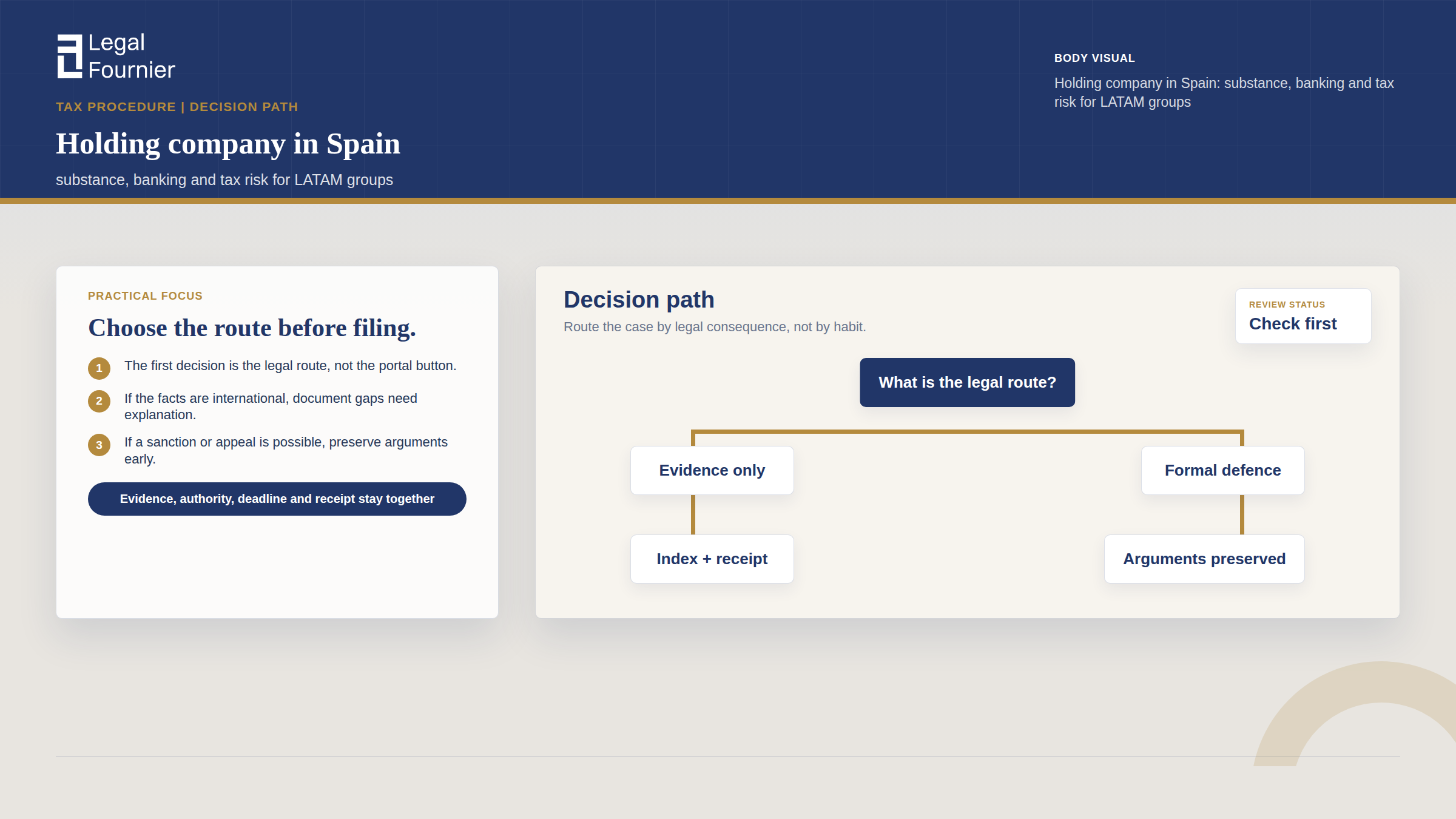
A premium bank file for a Spanish holding company will usually include:
| Bank question | Evidence to prepare | Why it matters |
|---|---|---|
| Who ultimately owns the company? | Group chart, foreign registry extracts, shareholder registers, passports, tax IDs and beneficial-owner declarations. | The bank must identify natural-person control, not just the first corporate shareholder. |
| What will the account be used for? | Business plan, expected transaction matrix, contracts, dividend policy, investment memo and invoice flow. | Unexpected countries, amounts or counterparties can trigger later reviews or account restrictions. |
| Where does the money come from? | Audited accounts, sale agreements, dividend history, tax returns, bank statements and source-of-wealth explanations. | Substantial foreign capital needs a documented origin, not a verbal explanation. |
| Who will operate the account? | Director appointment, powers of attorney, board resolutions, digital certificate control and signing policies. | Authority must match the corporate and banking documentation. |
If the Spanish company expects to open a bank account for business operations, coordinate the banking file with Spanish bank account planning. A rejected onboarding can delay tax registrations, capital movements, payroll, property completions and commercial contracts.
Related-party and anti-abuse risk
Holding companies generate intra-group transactions. A Spanish company may charge management fees, receive dividends, make shareholder loans, pay interest, license intellectual property, provide guarantees, buy assets from a related company or employ executives who also work for other group entities. Each of those transactions should be priced and documented before money moves.
Article 18 of the Corporate Income Tax Law requires transactions between related persons or entities to be valued at market value, meaning the value that would have been agreed by independent parties under free-competition conditions. The list of related parties includes, among others, an entity and its shareholders, an entity and its directors or administrators, entities in the same group and certain indirectly held entities.
The Ley General Tributaria also matters. Article 15 addresses conflicto en la aplicacion de la norma tributaria, where artificial or improper acts reduce tax without relevant legal or economic effects beyond tax savings. Article 16 addresses simulation, where the taxable event is treated as the one effectively carried out by the parties. A Spanish holding with no coherent commercial explanation, no documentary discipline and circular cash movements can invite this kind of analysis.
This does not mean that tax-efficient holding structures are prohibited. It means that the legal design has to match commercial reality. For a LATAM group, we would normally test at least these points:
- Business purpose. Why Spain, why now, and why this entity in the group chart?
- Decision trail. Where are board meetings held, who attends, what is decided and what documents prove it?
- Transaction pricing. Are loans, services, guarantees and management fees documented on terms that independent parties could defend?
- Treaty position. Which LATAM country is involved, which treaty applies, and does the structure have access to treaty benefits in practice?
- Personal-tax interaction. What happens if a founder, director or family shareholder becomes Spanish tax resident?
A practical pre-incorporation checklist
For a substantial LATAM group, the safest sequence is not “incorporate first, solve later”. It is a controlled project with legal, tax, banking and documentary workstreams.
- Map the current group. Identify every company, shareholder, beneficial owner, country, asset class and expected flow into or out of Spain.
- Define the Spanish function. Decide whether the entity will hold shares, manage investments, own assets, employ people, provide services or coordinate operations.
- Run the permanent establishment analysis. Review offices, employees, directors, agents, contract authority, remote work and treaty rules by relevant LATAM country.
- Test the tax regime. Review ordinary Corporate Income Tax treatment, Article 21 participation exemption, possible ETVE election, withholding and related-party documentation.
- Prepare the banking pack. Build the source of funds, source-of-wealth, beneficial-ownership and expected-transaction file before approaching banks.
- Align directors and powers. Decide who will manage the company, where decisions will be made, who signs bank and tax filings, and how powers of attorney will be limited.
- Plan accounting from day one. Spanish companies must keep proper accounts and annual corporate records. The holding company’s accounting should be ready for dividends, loans, management fees and group charges.
If the Spanish company will be active rather than purely holding shares, the setup should also be coordinated with monthly accounting support, employment or director-remuneration advice, and any sector-specific licenses.
When a Spanish holding company Is usually a better fit
A Spanish holding company is more defensible when Spain has a real function in the group, not only a tax aspiration. Stronger cases often include a planned Spanish investment platform, a family relocation path, Spanish or European assets, genuine governance in Spain, a clear director profile, documented shareholder wealth and coherent flows with operating subsidiaries.
Weaker cases often include rushed incorporation, nominee-like directors with no real decision role, no banking narrative, foreign contracts signed casually from Spain, unexplained capital movements, shareholder loans with no terms, or a structure that exists only to receive dividends while all decisions, people and risks remain elsewhere.
The distinction is not moral; it is evidentiary. A strong holding file makes the facts legible to the AEAT, the bank, the notary, accountants and foreign advisers. A weak file leaves each institution to infer the purpose of the structure from incomplete documents.
FAQ: Spanish holding company for a LATAM group
Can a LATAM group use a Spanish SL as a holding company?
Yes, a Spanish SL can be used in a holding structure, but the correct design depends on the countries involved, shareholders, subsidiaries, expected flows, management location, bank profile and tax objectives. It should not be treated as a generic template.
Does a Spanish holding company automatically avoid permanent establishment risk?
No. Permanent establishment risk depends on the activity carried out in Spain for a non-resident company, including fixed places of business and agents with habitual contracting authority, subject to the relevant treaty. A Spanish holding may solve one corporate need while leaving a separate PE issue for a LATAM operating entity.
Is the ETVE regime always the best option?
No. ETVE can be useful for certain holding structures, but it has statutory conditions and needs review with the participation exemption, the foreign subsidiaries’ tax position, the shareholder profile, anti-abuse rules and the group’s commercial purpose.
Will a Spanish bank open the account once the company is incorporated?
Not automatically. Banco de Espana guidance recognizes that banks generally decide whether to open accounts according to their internal policies and risk criteria, subject to non-discrimination rules. AML documentation, beneficial ownership, source of funds and expected activity are often decisive.
Does the director need to live in Spain?
Not in every case, but director residence, board practice and decision-making location affect the evidence of substance and effective management. A non-resident director structure can work in some cases, but it needs careful powers, minutes, tax residence analysis and bank onboarding planning.
What documents should be ready before incorporation?
At minimum, prepare the ownership chart, beneficial-owner evidence, shareholder and director IDs, foreign company registry documents, source of funds explanation, expected-transaction matrix, tax residence analysis, proposed bylaws, powers and banking narrative. Complex LATAM groups often need apostilles or legalizations and translations before the Spanish timeline starts.